
Core i5 14600k vs Core i5 13600k, Worth Upgrading?

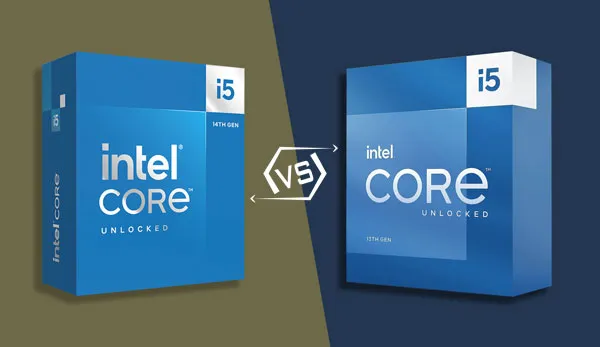
From the Intel Core i5-11600K to the i5-12600K and i5-13600K, the advancements were huge, and we'd expect the same from the 14600K. Intel's 14th-generation CPUs are actually a refresh of 13th-generation chips, so that's not how it worked. The new Core i5-14600K from Intel isn't a huge leap in technology. As Intel's 13th-generation CPUs are already top-tier, it was unexpected. Since both are around the same price, the bigger question is whether it's worth buying over last year's Core i5-13600K.
Core i5-14600K and i5-13600K launched roughly a year apart on Oct. 17, 2023, and Oct. 20, 2022, respectively. Officially, they cost $320, although the i5-13600K now sells for $300 or less, which isn't much.
Architecture and Design
To begin with, it is worth noting that the Core i5-14600K and Core i5-13600K have a common manufacturing process node of 10nm by Intel, which underscores the similarity in their production technologies. The Core i5-14600K is equipped with a base frequency of 3.5 GHz and is capable of achieving a maximum turbo boost speed of 5.3 GHz. In contrast, the Core i5-13600K operates at the same 3.5 GHz but has a marginally lesser maximum turbo boost speed of 5.1 GHz. The 125W TDP of both processors indicates similar power consumption during gaming and other workloads. Both CPUs have good performance, which makes them the best CPUs to put in a gaming PC.
For integrated graphics, the Core i5 14600K offers Intel UHD Graphics and a 1.55 GHz GPU. But the Core i5 13600K runs at 1.50 GHz. The difference may not be significant, but it can affect integrated graphics gaming benchmarks.
The Core i5-13600K and i5-14600K are hybrid Raptor Lake CPUs with P-cores and E-cores. P-cores are powerful but take up a lot of CPU space and power, while E-cores are slow but more efficient. Both chips have 6 P-cores and 8 E-cores, with more of the smaller E-cores since P-cores boost single-threaded performance, and boosting multi-threaded performance is easier with more E-cores. With 14 cores and 20 threads, the Core i5-14600K and Core i5-13600K both provide similar core and threading capabilities. The incorporated graphics solution of both processors, UHD Graphics 770, guarantees parallel graphics capabilities.
Both CPUs are compatible with DDR4 and DDR5 memory, allowing for a wide range of RAM options. They support ECC memory, making them suitable for workstations and servers that need data integrity.
Overall, the specifications of the Core i5-14600K and Core i5-13600K are nearly identical, making them easy to confuse. Aside from a 100MHz increase in the boost clock speed of the efficient core, both processors feature an identical number of cores, cache capacity, and boost clock speed. Additionally, both are constructed using the Intel 7 process, indicating that no significant architectural change has occurred.
Which Is Highly Recommended: The Core i5-13600K or the Core i5-14600K?
According to some evaluations, the Core i5-14600K provides users with 2.2% higher FPS and 2.8% better thermal management than the Core i5-13600K. In addition, in comparison to the Core i5-14600K, the Core i5-13600K offers enhanced power efficiency by 5.9% and a reduced price by 6.5%. The performance capabilities of the two components differ by a negligible margin. As a low-end processor of their generation, the Core i5 14600K is marginally superior to its predecessor. Increased boost clock speed is credited for the little performance improvement. Core i5 13600K has a 5.10GHz performance core boost and a 3.90GHz efficiency core. Core i5 14600K's performance, efficiency, and core boost speed are slightly superior. Its performance core boost clock is 5.30GHz, while its efficiency core boost is 4.00GHz. This edge is small; thus, it may not be visible for regular work and games. For individuals who need every bit of power, the Core i5-14600K is somewhat better.
Conclusion
In conclusion, the comparison between Intel's Core i5-14600K and Core i5-13600K reveals minimal differences, emphasizing the incremental nature of advancements in the 14th-generation CPUs. Both processors share a 10nm manufacturing process, 6 P-cores, and 8 E-cores and support DDR4 and DDR5 memory. The slight performance edge of the Core i5-14600K, with a 2.2% FPS increase and 2.8% better thermal management, comes at the cost of a 6.5% higher price compared to the i5-13600K, which offers better power efficiency and a lower price point. The architectural similarities and marginal performance disparities suggest that the upgrade may not be significant for regular work and gaming. Ultimately, the choice between the two depends on individual preferences and the specific demands of the user, with the Core i5-13600K standing out for its enhanced power efficiency and lower price.
Discussion (0)
No comments found.
Post a Comment
Your email address will not be published.
Related Articles

The Tech Pulse of 2026: Dubai's Gaming Hardware Revolution
The ultimate guide to Gaming News & Technology for the AE community. Focusing on Silicon trends in Dubai with expert insights from GCC Gamers.
Gaming and Beyond: Features that Make the Gigabyte X870-A Elite Wifi7 Perfect for Power Users
Unlocking Exceptional Performance and Versatility for Gamers, Creators, and Tech Enthusiasts Alike The Gigabyte X870-A Elite Wifi7 Motherboard is a high-perfor...
Why is the NZXT H5 Flow White is the Ultimate Mid-Tower Case for Airflow and Cable Management?
Discover Unmatched Cooling and Streamlined Cable Management in the Compact and Versatile NZXT H5 Flow Case Unmatched Airflow and Enhanced GPU Cooling in a Comp...
AMD Threadripper Showdown: 5995WX vs. 7995WX - Which Reigns Supreme?
The quest for the ultimate gaming processor often leads to a showdown between titans, and in the world of high-end desktop CPUs, the AMD Threadripper series is ...


