
ASUS Ascent GX10: A Compact AI Supercomputer for Developers

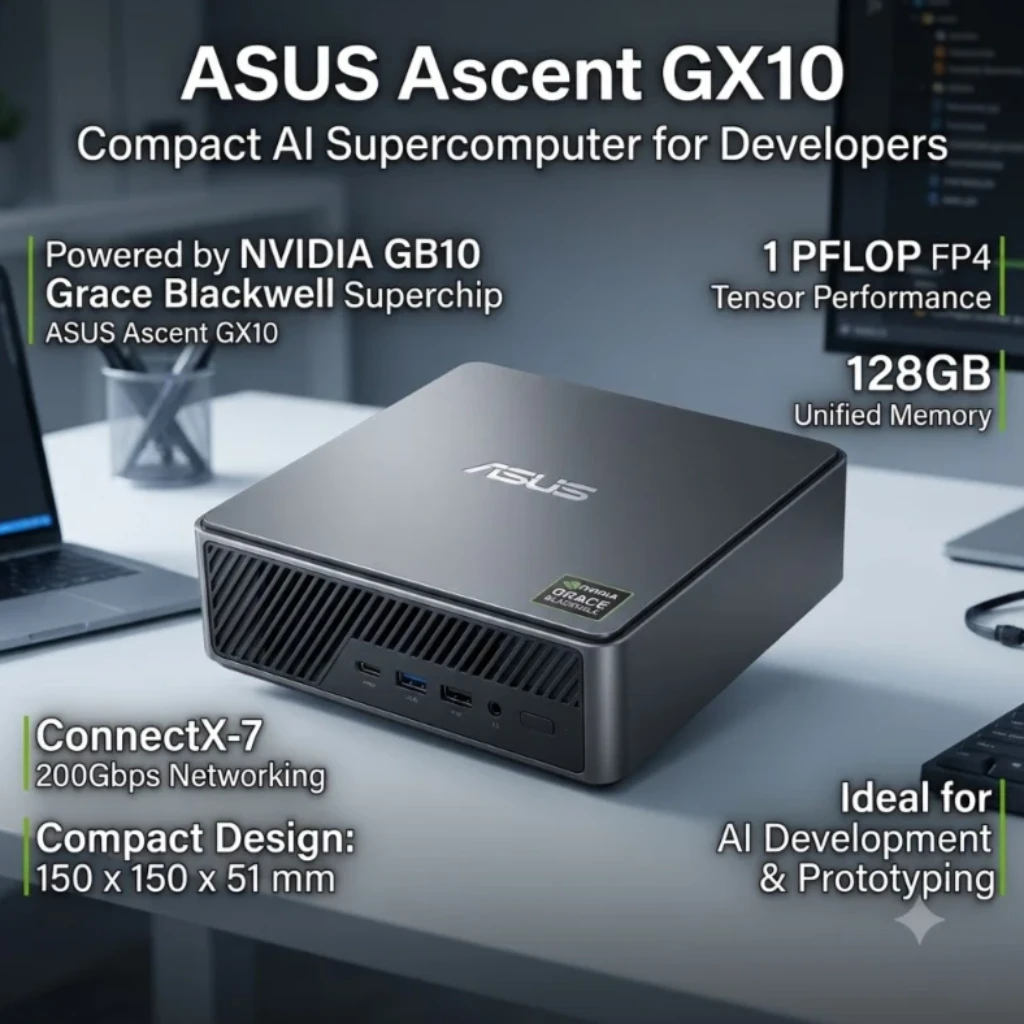
Artificial intelligence is changing how developers build software, researchers experiment with machine learning models, and businesses introduce intelligent applications. As AI workloads become more demanding, professionals need computing systems that deliver substantial processing power without requiring a large server infrastructure. The ASUS Ascent GX10 addresses this need with a compact AI computing platform powered by the NVIDIA GB10 Grace Blackwell Superchip.
Designed for AI development, model prototyping, inference, and research, the ASUS Ascent GX10 combines NVIDIA Blackwell GPU architecture, 128GB of coherent unified memory, and an NVIDIA AI software stack in a small desktop-sized system. For AI developers and technology businesses in the UAE, it offers an option worth considering for local AI development and experimentation.
What Is the ASUS Ascent GX10?
The ASUS Ascent GX10 is a compact AI computing system designed to support demanding AI development and deployment workflows. Unlike a conventional desktop PC intended primarily for general productivity or gaming, it is built around a platform specifically designed for AI computing.
At its core is the NVIDIA GB10 Grace Blackwell Superchip, which combines an Arm-based CPU architecture with NVIDIA Blackwell GPU technology. The system delivers a specified theoretical FP4 tensor performance of 1 PFLOP using sparsity, alongside 128GB of coherent unified system memory.
Its compact dimensions of 150 × 150 × 51 mm make it suitable for environments where desk space is limited. Despite its small footprint, the system includes high-speed networking, wireless connectivity, USB Type-C ports, and an HDMI display output.
The ASUS Ascent GX10 runs NVIDIA DGX OS and includes the NVIDIA AI software stack, providing a platform for developers working with supported AI frameworks and tools. You can explore the ASUS Ascent GX10 AI computer at GCC Gamers UAE for product details.
Key Features of the ASUS Ascent GX10
1. NVIDIA GB10 Grace Blackwell Superchip
The NVIDIA GB10 Grace Blackwell Superchip is the central component of the ASUS Ascent GX10. It combines CPU and GPU processing capabilities to support AI workloads that benefit from accelerated computing.
The system features a 20-core Arm CPU comprising 10 Cortex-X925 cores and 10 Cortex-A725 cores. Its GPU uses NVIDIA Blackwell architecture, with fifth-generation Tensor Cores and fourth-generation RT Cores.
The specified 1 PFLOP of tensor performance refers to theoretical FP4 performance using sparsity. Actual results depend on the workload, software, model configuration, and other operating conditions.
For developers, this hardware platform can support experimentation with AI models, accelerated inference, and other computationally intensive tasks without requiring every development workflow to run on a remote cloud server.
2. 128GB of Coherent Unified Memory
Memory capacity is an important consideration when selecting hardware for large AI models. The ASUS Ascent GX10 features 128GB of LPDDR5x coherent unified system memory, with a 256-bit memory interface and bandwidth of up to 273GB/s.
Unified memory allows the CPU and GPU to work within a shared memory architecture, which can be useful for supported AI workloads involving large models and datasets.
ASUS identifies the platform as suitable for workloads such as fine-tuning models with up to 200 billion parameters. However, this should not be interpreted as a guarantee that every model of that size will run efficiently under all conditions. Actual feasibility depends on factors such as quantization, model architecture, memory requirements, and the specific workload.
For AI researchers and developers, the available memory can be an important consideration when evaluating the system for local model development and experimentation.
3. A Platform for Agentic AI Development
Agentic AI systems can perform multi-step tasks, use tools, and execute workflows with varying levels of autonomy. Developing these systems requires more than model inference alone; developers may also need environments for testing, orchestration, debugging, and security controls.
The ASUS Ascent GX10 is positioned for agentic AI development through its NVIDIA AI software stack and the developer tools described in its product materials, including NemoClaw and OpenShell.
These technologies are intended to support agent development and controlled execution environments. Their availability and functionality depend on software versions, configuration, and compatibility.
For AI startups and independent developers, a dedicated AI computer can provide a convenient environment for prototyping agent-based applications, testing workflows, and experimenting with local inference. The ASUS Ascent GX10 at GCC Gamers UAE is worth exploring if you are evaluating compact hardware for these development tasks.
4. High-Speed Networking and Dual-System Connectivity
The ASUS Ascent GX10 includes an NVIDIA ConnectX-7 network interface rated at 200Gbps, as well as a separate 10GbE RJ-45 connection. It also supports Wi-Fi 7 and Bluetooth 5.4.
The ConnectX-7 interface and NVLink-C2C technology support the platform's interconnected architecture. ASUS describes dual-system stacking as an option for scaling beyond a single system.
This connectivity can be relevant to developers who want to explore multi-system AI configurations. However, actual scaling performance depends on supported software, system configuration, and the workload being executed.
5. Compact Design for Offices and Research Environments
Traditional AI infrastructure can require considerable space, cooling, and power planning. The ASUS Ascent GX10 measures just 150 × 150 × 51 mm and weighs approximately 1.48kg.
Its compact form factor makes it easier to accommodate in development offices, research laboratories, and suitable edge-computing environments.
The system has a specified 240W power supply and an engineered thermal design for maintaining performance under demanding workloads. Cooling requirements and operating conditions should still be considered when planning extended AI workloads.
Technical Specifications of ASUS Ascent GX10
| Specification | Details |
| Processor architecture | NVIDIA Grace Blackwell |
| Superchip | NVIDIA GB10 Grace Blackwell Superchip |
| CPU | 20-core Arm: 10 Cortex-X925 + 10 Cortex-A725 |
| GPU architecture | NVIDIA Blackwell |
| Tensor Cores | Fifth generation |
| RT Cores | Fourth generation |
| Tensor performance | 1 PFLOP theoretical FP4 performance using sparsity |
| System memory | 128GB LPDDR5x coherent unified memory |
| Memory bandwidth | Up to 273GB/s |
| Storage options | 1TB or 2TB PCIe 4.0 x4 NVMe SSD; 4TB PCIe 5.0 x4 NVMe SSD |
| Networking | 200Gbps NVIDIA ConnectX-7 NIC and 10GbE LAN |
| Wireless connectivity | Wi-Fi 7 and Bluetooth 5.4 |
| Operating system | NVIDIA DGX OS |
| Power supply | 240W |
| Dimensions | 150 × 150 × 51 mm |
| Weight | 1.48kg |
Who Should Consider the ASUS Ascent GX10?
The ASUS Ascent GX10 is designed for several professional AI use cases.
AI developers: Developers can use the system to build and test AI applications, experiment with supported frameworks, and run compatible inference workloads.
Machine learning researchers: The combination of unified memory and accelerated computing may be useful for model experimentation, research workflows, and supported fine-tuning tasks.
Data scientists: Professionals working with data processing, model evaluation, and AI-powered analytics can consider the system according to their software and memory requirements.
AI startup founders: Startups developing AI products may benefit from having dedicated local hardware for prototyping and testing before deciding whether to deploy workloads to larger infrastructure.
Healthcare, fintech, industrial AI, and retail teams: Organizations in these sectors can evaluate the platform for suitable research, development, and proof-of-concept projects. Production deployment requires separate assessment of security, compliance, reliability, and workload requirements.
ASUS Ascent GX10 for Local AI vs. Cloud Computing
One of the main considerations when investing in AI hardware is whether to run workloads locally or use cloud-based infrastructure.
A local AI system can provide direct access to dedicated hardware, predictable availability of the installed resources, and the option to keep supported workloads and data within an organization's own environment. This can be valuable for development teams that frequently experiment with models or work with data that requires additional control.
Cloud computing, on the other hand, provides access to a wider range of computing resources without requiring the organization to purchase and maintain all the hardware itself. It can be more suitable for occasional experiments, highly variable demand, or workloads that exceed the capacity of a compact system.
The ASUS Ascent GX10 may fit into a hybrid strategy in which developers use local hardware for daily development and testing while relying on larger infrastructure when additional capacity is necessary.
Is the ASUS Ascent GX10 Worth Considering?
The ASUS Ascent GX10 stands out for combining a compact physical design with the NVIDIA GB10 Grace Blackwell Superchip, 128GB of unified memory, and high-speed networking.
It is worth evaluating for AI developers, researchers, and startups seeking a dedicated platform for local AI development, inference, and supported agentic AI workflows. Its suitability depends on the applications you intend to run, model memory requirements, software compatibility, and whether its fixed storage configuration meets your needs.
Before making a purchase, compare the specifications with your intended workloads and review any additional software licensing requirements. NVIDIA AI Enterprise, for example, is available separately according to the datasheet.
Explore ASUS Ascent GX10 at GCC Gamers UAE
For developers and businesses looking for AI computing hardware, GCC Gamers UAE provides workstation configurations to explore.
If you are looking for a compact AI computer with substantial unified memory and an NVIDIA accelerated computing platform, view the ASUS Ascent GX10 product page to review its available product information.
You can also browse the GCC Gamers UAE workstation category to compare other systems for professional computing requirements.
Choose a system based on your actual workloads, technical requirements, and budget to build an AI development environment suited to your goals.
Discussion (0)
No comments found.
Post a Comment
Your email address will not be published.
Related Articles
How Can the ASUS ProArt GR1X Accelerate Local AI Development?
Explore ASUS ProArt GR1X features, NVIDIA AI performance, up to 128GB unified memory, and local AI development capabilities.
How Can the ASUS ExpertCenter Pro ET900N G3 Accelerate AI Development?
Explore ASUS ExpertCenter Pro ET900N G3 features, NVIDIA GB300 performance, 748GB coherent memory, and AI development capabilities in the UAE.

How to Choose the Best AI Workstation in UAE for Your Business
Learn how to choose an AI workstation in UAE by comparing GPU, VRAM, CPU, RAM, storage, and configurations for your business.

Forget the Cloud: The Best Local AI PC Custom Builds for UAE Developers!
Why rent GPU clouds? Read our technical guide on building local deep learning workstations, multi-GPU configurations, and high-VRAM AI setups.


