
Why Choose a Local AI Workstation in Bahrain for Data Privacy and Secure Computing?

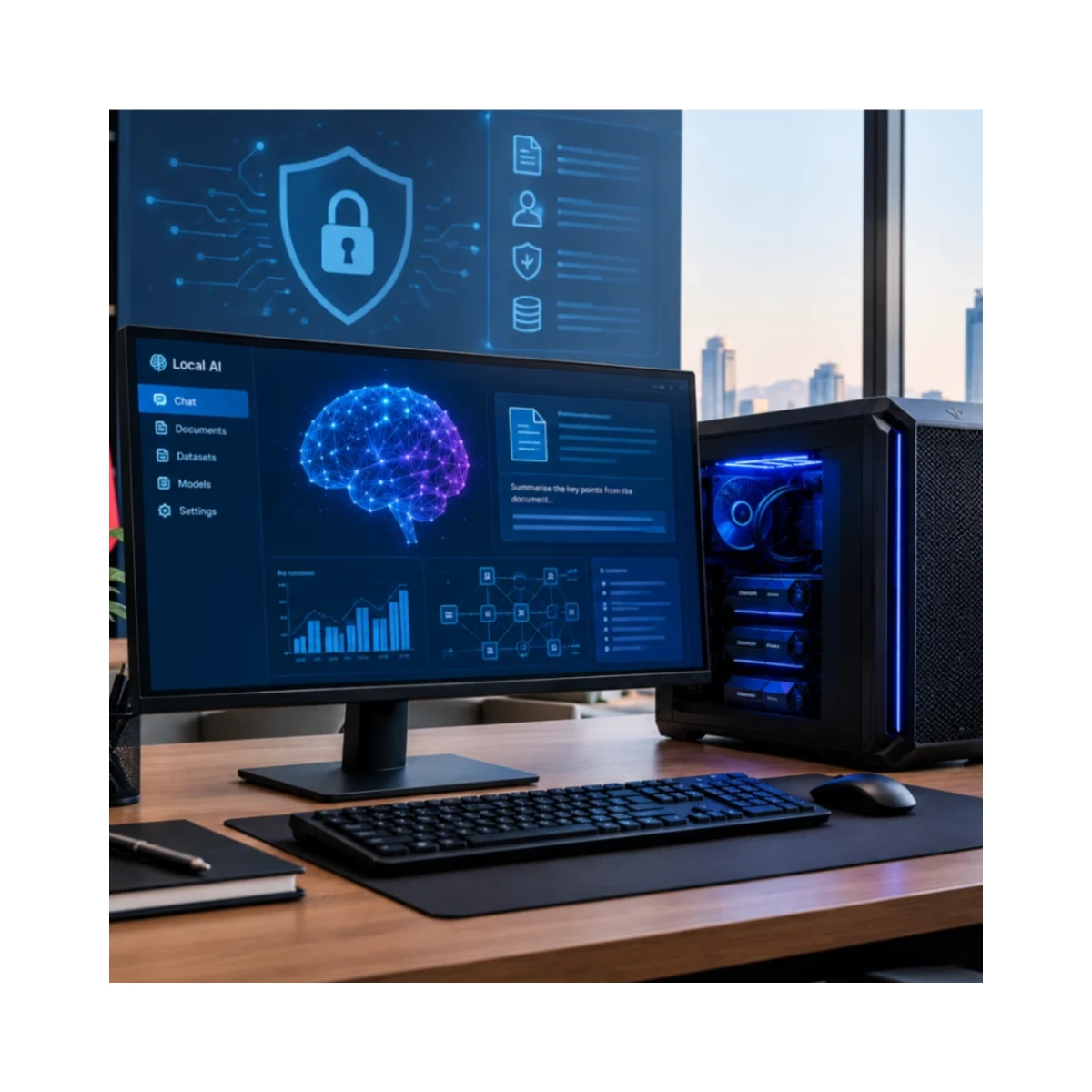
Artificial intelligence is changing how organisations process information, automate tasks, and develop new digital services. From analysing internal documents to building intelligent business applications, AI tools can handle increasingly complex workloads. However, when these tasks involve confidential files, customer records, financial information, or proprietary business data, organisations must consider how that information is processed and stored.
For businesses in Bahrain, a local AI workstation offers one way to run compatible AI applications within their own computing environment. Instead of sending every prompt or document to an external AI service, organisations can run selected models locally and maintain greater control over their data, access permissions, and computing infrastructure.
Understanding how local AI computing works can help businesses decide whether a dedicated AI workstation fits their security requirements and operational needs.
What Is a Local AI Workstation?
A local AI workstation is a computer designed to run AI software directly on the machine or within an organisation's local network. Depending on its hardware and software configuration, it can support language models, document analysis, image recognition, data processing, and other AI applications.
Unlike a workflow that depends entirely on a cloud-based AI service, local processing allows compatible models to operate without sending every request to an external inference provider.
A local AI workstation may be used to:
- Run supported large language models (LLMs) locally.
- Analyse internal documents and technical files.
- Develop private AI assistants for employees.
- Test machine learning applications using internal datasets.
- Process selected image, video, or business data locally.
- Create prototypes before deploying AI applications to production.
Local execution does not automatically make a system secure. The organisation still needs appropriate access controls, encryption, software updates, and a well-designed network environment.
How Local AI Computing Can Improve Data Control
Data privacy is an important consideration when adopting AI, particularly when employees use AI tools to work with sensitive information.
When a business uses an external AI service, the information submitted may be transmitted to the service provider. How that information is retained, processed, or used depends on the provider's terms, configuration, and applicable agreements.
A locally operated AI workstation can reduce the need to transfer certain information outside the organisation.
1. Keep Sensitive Documents Within Your Environment
Businesses regularly work with contracts, internal reports, customer correspondence, product documentation, and other confidential files.
With a properly configured local AI application, authorised employees can use AI to search, summarise, or extract information from compatible documents without uploading the source files to a third-party AI service.
For example, a company could create an internal document assistant that helps employees locate information in approved business files. The documents and model can be hosted locally, subject to the application's architecture and configuration.
2. Reduce Dependence on External AI Services
Cloud AI services can be useful for rapid deployment and access to hosted models. However, organisations may prefer local processing when they need greater control over where data travels.
A local AI workstation can support selected workflows even when an external AI inference service is not being used. This may be helpful for internal experimentation, sensitive document processing, or development environments with restricted external connectivity.
Some applications still require internet access for licensing, software updates, external data sources, or other functions. These dependencies should be reviewed before deployment.
3. Establish More Direct Access Controls
When AI applications operate within an organisation's own environment, administrators can integrate them with existing security measures where supported.
These measures may include individual user accounts, role-based permissions, network restrictions, disk encryption, and controlled access to datasets.
For example, an internal AI assistant could be configured to retrieve documents only from folders that the requesting employee is authorised to access. This requires appropriate application-level permissions; simply installing a model locally does not provide this protection automatically.
Why Businesses in Bahrain May Consider Local AI
Different organisations have different security, infrastructure, and performance requirements. A local AI workstation can be particularly relevant when AI projects involve proprietary information or repeated processing of internal data.
Financial and Professional Services
Financial teams, consultants, and professional service providers may work with sensitive reports, internal research, and confidential documents. A locally hosted AI workflow can help analyse approved information while reducing the need to transmit it to an external AI provider.
Any deployment involving regulated information should also be reviewed against the organisation's legal, contractual, and sector-specific obligations.
Healthcare and Research Environments
Healthcare organisations and research teams may handle sensitive records or unpublished research. Where permitted, a locally managed AI environment can support document classification, research assistance, or analysis of approved datasets.
Access restrictions, de-identification where appropriate, audit logging, and applicable privacy requirements remain essential.
Software Development and Technology Companies
Technology teams may use AI to examine source code, explain internal documentation, test application features, or build specialised AI tools.
Running compatible models locally can help teams experiment with proprietary code and development materials without routinely sending them to an external AI service.
Businesses Handling Internal Knowledge
Companies of many sizes accumulate information across policies, manuals, procedures, reports, and technical documents. A locally hosted retrieval-augmented generation (RAG) system can connect an AI model to an approved document collection and generate responses based on retrieved material.
The quality of the results depends on document preparation, retrieval methods, permissions, and model performance. Responses should be checked when accuracy is important.
Choosing Hardware for Secure Local AI
Although security depends heavily on software and administration, workstation hardware determines which models and workloads can run effectively.
GPU Memory for Local AI Models
GPU memory, also known as VRAM, is an important consideration when running AI models locally. Larger models and longer input contexts can require more memory, while quantisation may reduce memory requirements at the cost of potential changes in output quality.
Before purchasing a workstation, identify the models you intend to run and check their practical hardware requirements. Do not assume every model will fit or perform well simply because a workstation has a powerful GPU.
System RAM and Storage
System RAM supports the operating system, AI applications, document processing, and other concurrent workloads. Projects involving large datasets or several applications may require additional memory.
Fast NVMe storage can help manage model files, datasets, and application environments. Capacity should be planned around the volume of information being processed and retained.
For confidential information, storage encryption, access permissions, backup protection, and secure disposal procedures are also important. These protections must be configured correctly rather than assumed to be included automatically.
Reliable Cooling and Expandability
Local AI workloads can keep GPUs and CPUs under sustained load. Appropriate cooling and power delivery help maintain stable operation.
Organisations expecting to expand their AI usage should also consider memory capacity, GPU support, storage expansion, and maintenance requirements before selecting a system.
Local AI Workstation vs Cloud AI: What Should You Consider?
A local workstation and a cloud AI service can both be appropriate, depending on the workload.
| ConsiderationLocal AI workstationCloud AI service | ||
| Data handling | Can keep compatible processing within a controlled local environment | Data handling depends on provider, service, and configuration |
| Initial investment | Requires purchasing and maintaining hardware | Often allows usage without buying a dedicated AI server |
| Ongoing costs | Electricity, maintenance, upgrades, and support | Usage charges, subscriptions, or contracted capacity |
| Model choice | Limited by installed hardware and compatible software | Depends on models and services offered by the provider |
| Internet dependency | Local inference can work offline when all required components are available | Hosted inference generally requires network access |
| Scaling | May require additional hardware | Capacity can often be adjusted through the service |
| Security responsibilities | Organisation manages endpoint, network, application, and physical security | Responsibilities are shared between customer and provider |
Some organisations may benefit from a hybrid approach: sensitive workloads run locally, while other tasks use approved cloud services. The appropriate design depends on risk, cost, model requirements, and operational priorities.
Security Practices for a Local AI Workstation
To get meaningful privacy benefits, businesses should implement a security plan alongside the hardware.
Use approved AI software. Download models and applications from trusted sources, verify their origin, and keep dependencies updated.
Restrict access to sensitive information. Apply least-privilege permissions to user accounts, datasets, model interfaces, and shared folders.
Protect stored data. Use suitable encryption, secure backups, and retention policies for confidential files and model outputs.
Control network access. Limit unnecessary inbound and outbound connections, and review whether the workstation needs internet access for each application.
Review AI data flows. Check whether prompts, logs, telemetry, crash reports, or connected tools send information to external services.
Monitor usage. Maintain appropriate logs and review access to sensitive datasets, while ensuring that monitoring itself follows applicable privacy requirements.
Test the system. Evaluate how the model handles unauthorised requests, malicious documents, prompt injection, and attempts to retrieve information outside a user's permissions.
These measures help reduce risk, but no single workstation configuration can guarantee complete security or eliminate every AI-related threat.
Explore AI Workstations at GCC Gamers Bahrain
For organisations planning to run AI models locally, the workstation should match the intended workload, required model size, and data-handling strategy.
GCC Gamers offers configurations that can be evaluated for demanding AI computing tasks:
- AI Development Workstation: Consider this configuration for compatible AI development and GPU-accelerated experimentation.
- AI Research Workstation: Explore this option for memory-intensive development and research workloads.
- Hyperion AI Workstation: Review this multi-GPU configuration for applications capable of benefiting from multiple graphics cards.
Before purchasing, verify the current specifications, model compatibility, security requirements, and availability of each configuration. Hardware alone does not determine whether an AI workflow is private; software architecture and system administration matter just as much.
Conclusion
A local AI workstation can give businesses in Bahrain more control over how selected AI workloads process confidential information. It can support internal document assistants, local model experimentation, software development, and other workflows where limiting external data transfers is valuable.
The best approach begins with identifying sensitive data, choosing compatible AI software, and establishing clear security controls. Businesses should then select hardware that meets their performance requirements without overlooking ongoing costs, maintenance, and future expansion.
Explore AI workstations at GCC Gamers Bahrain to compare available configurations for local AI computing and secure development workflows.
Discussion (0)
No comments found.
Post a Comment
Your email address will not be published.
Related Articles

Bahrain's Gaming Evolution: Silicon Breakthroughs in Manama
The ultimate guide to Gaming News & Technology for the BH community. Focusing on Tech infrastructure in Bahrain with expert insights from GCC Gamers.

Manama's Custom Scene: The Art of the Balanced Build
The ultimate guide to Gaming PC Builds & Setups for the BH community. Focusing on Bang-for-buck custom rigs with expert insights from GCC Gamers.

The Bahraini Tuning Guide: Overcoming Regional Heat Throttling
The ultimate guide to PC Optimization & Troubleshooting for the BH community. Focusing on Thermal management tips with expert insights from GCC Gamers.
The Bahraini Component Lab: Performance vs Price Analysis
The ultimate guide to PC Components & Hardware for the BH community. Focusing on Secondary parts value with expert insights from GCC Gamers.


