
Can an AI Workstation Help Kuwait Businesses Automate Daily Tasks?

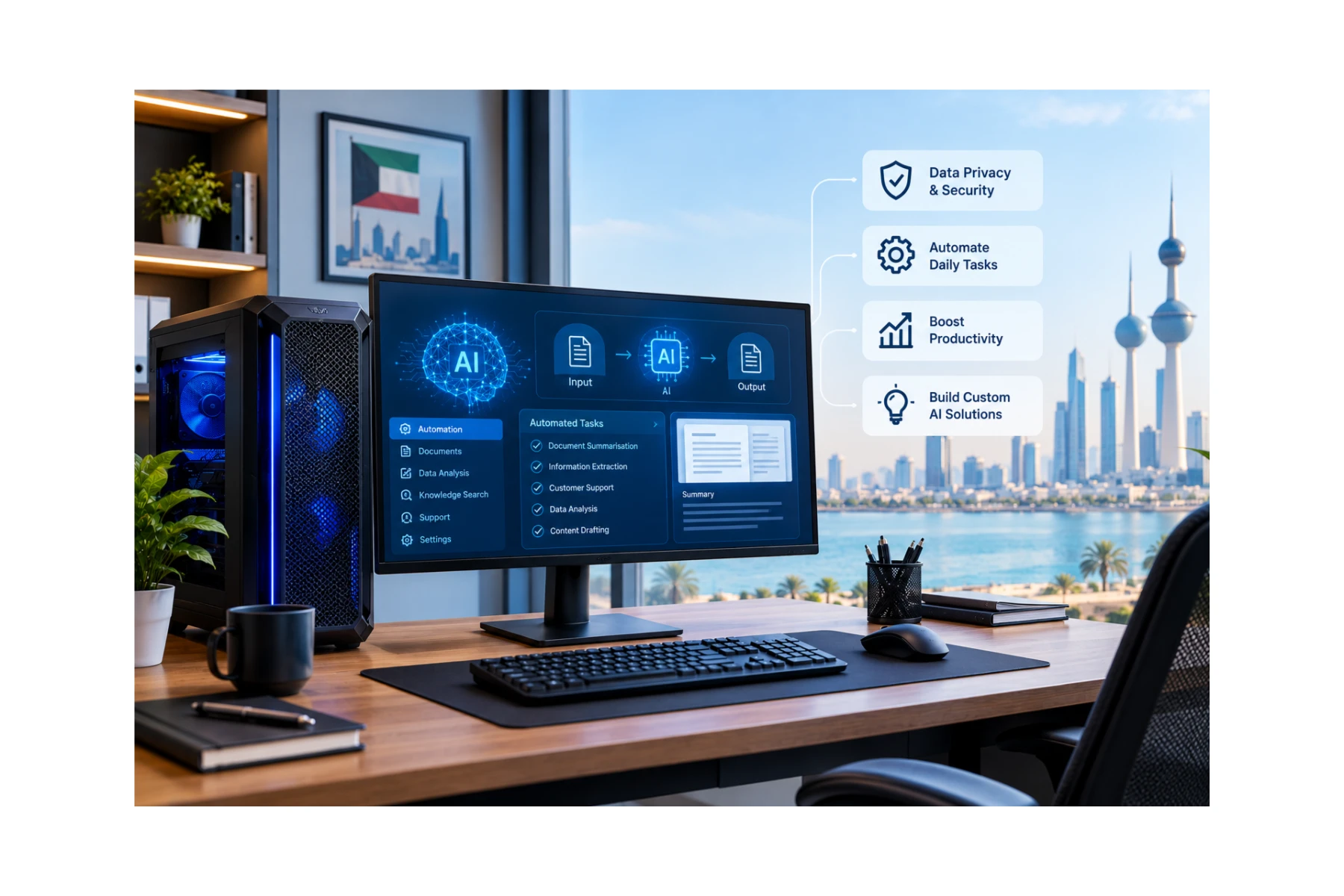
Businesses are increasingly looking for ways to reduce repetitive work, improve productivity, and make better use of their information. From preparing reports to processing documents and answering internal questions, many everyday tasks can be supported by artificial intelligence (AI).
For companies in Kuwait, an AI workstation can provide the computing resources needed to develop, test, and run AI-powered automation tools. Depending on the workload, businesses can use these systems to process documents, organise information, assist employees, and build applications that simplify routine operations.
Rather than replacing every existing business system, AI automation can help employees spend less time on repetitive tasks and more time on work that requires judgement, communication, and decision-making.
What Is AI-Powered Business Automation?
AI-powered automation combines AI models with software workflows to perform or assist with tasks that traditionally require manual effort. Unlike basic automation, which follows predefined rules, AI tools can interpret text, summarise information, classify documents, and generate responses.
An AI workstation provides a platform for running compatible models and developing automation applications. Businesses can use it for local processing, AI experimentation, and workloads that benefit from dedicated computing resources.
Examples include summarising lengthy reports, extracting information from invoices, searching company documents, and assisting with customer enquiries.
5 Daily Business Tasks an AI Workstation Can Help Automate
1. Document Processing and Report Preparation
Many businesses spend considerable time reviewing documents, preparing summaries, and organising information from different sources.
AI applications can help extract key details from invoices, contracts, purchase orders, and reports. They can also generate draft summaries for employees to review.
For example, an administrative team could use an AI-powered workflow to classify incoming documents and extract relevant fields before transferring them into an existing business system.
The final information should be checked, particularly when documents contain financial figures, contractual obligations, or other critical details.
2. Customer Support and Frequently Asked Questions
Customer service teams often respond to similar questions about products, services, delivery, procedures, and account processes.
A business can develop an AI assistant that uses approved company information to draft responses or help employees find relevant answers. A properly configured assistant can also direct complex enquiries to the appropriate team.
An AI workstation can support the development and testing of such applications. Whether the assistant runs locally or connects to external services depends on the software architecture.
Human review remains important for complaints, sensitive cases, and decisions that require professional judgement.
3. Internal Knowledge Search
Company information is often distributed across manuals, policy documents, spreadsheets, and internal reports. Employees may spend valuable time locating the correct information.
An AI-powered knowledge assistant can make approved documents easier to search using natural-language questions.
For example, an employee could ask about a company procedure and receive a summary based on relevant internal documents. Retrieval-augmented generation (RAG) can help connect an AI model to a company's document collection.
Access permissions and document quality must be managed carefully to ensure employees receive appropriate information.
4. Data Analysis and Business Reporting
Preparing routine reports can involve collecting data, identifying trends, and explaining results. AI tools can assist with summarising datasets, generating draft commentary, and highlighting patterns for further investigation.
Businesses in Kuwait could explore these workflows for sales summaries, inventory reporting, operational performance, or customer feedback analysis.
AI-generated findings should be validated against the original data. For calculations and financial reporting, reliable analytical software should perform the underlying computations rather than relying solely on generated text.
5. Content Drafting and Administrative Work
Marketing and administrative teams frequently prepare product descriptions, email drafts, meeting summaries, internal announcements, and other routine content.
AI applications can create initial drafts, organise notes, and adapt content for different audiences. Employees can then review the results for accuracy, tone, and compliance with company guidelines.
Automating the drafting stage can reduce repetitive effort while keeping final approval with the relevant employee.
Why Use an AI Workstation for Automation?
An AI workstation can be useful when a business wants a dedicated environment for developing and running AI applications.
Local processing: Compatible models can process selected workloads on the workstation, depending on the software and configuration.
Custom workflows: Businesses can build automation tools around their own documents, processes, and internal systems.
Dedicated computing resources: A suitable GPU, system memory, and storage can support AI applications that require more computing power than ordinary office tasks.
Development and testing: Technical teams can experiment with models, evaluate results, and refine workflows before wider deployment.
However, a powerful workstation does not automatically automate a business process. Effective implementation also requires suitable software, integration with existing systems, reliable data, and clear procedures for handling errors.
Which Businesses in Kuwait Could Benefit?
AI-powered automation can be explored across several business sectors.
- Retail and e-commerce: Product content, customer enquiry support, inventory summaries, and sales reporting.
- Professional services: Document summarisation, knowledge search, and preparation of draft reports.
- Logistics and distribution: Document classification, shipment-report summaries, and operational data analysis.
- Real estate: Property-description drafting, document organisation, and enquiry management.
- Small and medium-sized businesses: Administrative assistance, internal knowledge tools, and repetitive office-work support.
The most suitable tasks are usually repetitive, time-consuming, and easy to verify. Businesses should begin with a limited workflow, measure its results, and expand only when the process is reliable.
What Should Businesses Consider Before Getting Started?
Before investing in AI automation, identify the task that consumes the most time and determine whether AI can improve it.
- Define the objective: Decide whether you want to reduce document-processing time, improve information retrieval, or assist customer service.
- Choose suitable software: Confirm that the AI application supports your required workflow and business systems.
- Evaluate the workload: Determine whether local processing, cloud services, or a combination of both is appropriate.
- Plan the hardware: Match GPU memory, system RAM, and storage to the models and applications you intend to run.
- Protect business information: Establish access controls, data-handling rules, and appropriate security measures.
- Measure performance: Compare time saved, error rates, operating costs, and employee feedback before expanding the project.
Not every task needs a dedicated AI workstation. Lightweight applications may run on existing equipment or hosted services, while demanding local models and multiple concurrent workloads may benefit from more capable hardware.
Explore AI Workstations at GCC Gamers Kuwait
Businesses planning to develop AI automation tools can explore workstation configurations available through GCC Gamers Kuwait.
- AI Development Workstation: An option to evaluate for AI application development and GPU-accelerated experimentation.
- AI Research Workstation: Worth considering for more demanding computational and model-development workloads.
- Hyperion AI Workstation: A multi-GPU configuration to evaluate for compatible workloads that can benefit from multiple graphics cards.
Review current specifications, product availability, software compatibility, and the actual requirements of your automation projects before choosing a system.
Conclusion
An AI workstation can help businesses in Kuwait develop automation tools for document processing, customer support, internal knowledge search, reporting, and routine content creation.
The greatest benefit comes from choosing the right task, integrating AI into an appropriate workflow, and checking the accuracy of its output. With a clear implementation plan, businesses can use AI to reduce repetitive work and help employees focus on higher-value activities.
Explore AI workstations at GCC Gamers Kuwait to find hardware for your AI development and automation requirements.
Discussion (0)
No comments found.
Post a Comment
Your email address will not be published.
Related Articles

Kuwait's Competitive Edge: The Technology Shifts of 2026
The ultimate guide to Gaming News & Technology for the KW community. Focusing on Gaming innovation in Kuwait City with expert insights from GCC Gamers.

The Kuwaiti Builders Handbook: Engineering for Excellence
The ultimate guide to Gaming PC Builds & Setups for the KW community. Focusing on Advanced cable management with expert insights from GCC Gamers.

Zero-Lag Kuwait: The Complete Network and OS Tuning Guide
The ultimate guide to PC Optimization & Troubleshooting for the KW community. Focusing on Network optimization for gaming with expert insights from GCC Gamers.

Next-Gen Internals: Preparing Your Kuwaiti Rig for 2027
The ultimate guide to PC Components & Hardware for the KW community. Focusing on Future-proofing parts with expert insights from GCC Gamers.


